At HR Technologies France, Thomas posed a question that stopped the room: are we measuring the right things? Engagement scores have been HR's go-to metric for years. And yet, despite significant investment, most HR practitioners will tell you that the results aren't matching the effort.
Gallup's State of the Global Workplace 2025 report tells us that 58% of employees are struggling and 9% are actively suffering at work. And in France, the situation is even more desperate, with only 8% of French employees feeling engaged at work. Placing it among the lowest in Europe.
So why is it happening?
Engagement metrics fail for one crucial reason
Here's the problem with engagement as a measure: it's a symptom tracker. It shows you that something's wrong, but not what's causing it. When scores dip, leaders are left with a number and no clear path forward.
We've worked hard over recent years to find a way to address this, and we've come up with an entirely new way of measuring employee motivation - connection.
Where engagement captures how people respond to their environment — pay, recognition, culture — connection gets at the intrinsic motivators that make people want to do their best work. Trust. Belonging. Cohesion. Contribution, and more. These are the factors that sustain performance over time, and they're exactly what traditional engagement surveys miss.
Thomas research shows that an employee's sense of connection accounts for 56% of their decision to stay in or leave an organization. That's not a peripheral concern — it's right at the heart of the retention challenge HR leaders are grappling with right now.
So why isn’t everyone measuring connection?
The simple answer is that most HR platforms don't have the right data.
Many of the most prominent vendors in this space focus on the promise of a single, unified HR system – one platform to handle it all. It's an appealing proposition. But these systems are built around extrinsic data: headcount, performance ratings, pulse survey scores.
They don't capture the relational dynamics that actually drive team performance. They can't tell you whether a manager's communication style is creating friction, or whether a team's lack of psychological safety is quietly killing collaboration. Without that relational data, the "insights" they surface are limited.
Connection intelligence fills that gap. It makes the invisible visible, giving managers insights they can actually act on.
Where AI changes everything
The opportunity Nicolas Mathon highlighted at HR Technologies France was this: connection intelligence at scale.
Historically, providing personalised, relationship-focused support to every employee and manager hasn't been feasible. One-to-one coaching is expensive. Manager training rarely sticks. And the moments where people most need guidance — a difficult conversation, a new team dynamic, a performance review — rarely align with scheduled interventions.
AI changes the economics. With Thomas Connect, powered by our award-winning AI Coach, Thom, psychometric insight becomes something people can access in the flow of work. Thom draws on validated behavioral data to offer practical, personalised guidance. Not the generic advice you normally get, but specific coaching based on who you are and who you're working with... and at scale.
Ask Thom how to give feedback to a colleague who processes things differently to you. Ask it how to re-engage a team member who's gone quiet. It won't guess. It uses real people science to give you an answer you can act on immediately, in the everyday moments you actually need it
That's not replacing human connection - it's creating more of it, more often, between more people.

The six dimensions that actually drive performance
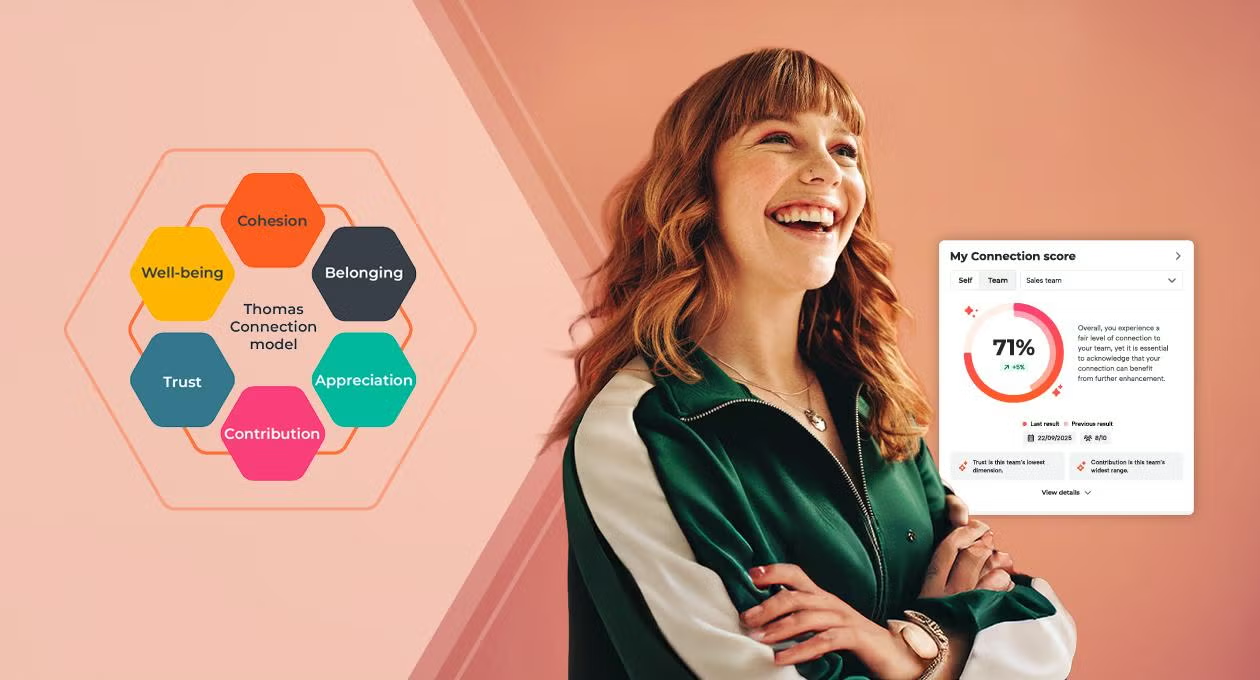
Thomas Connect is built on the Connection Model, a psychologist-validated framework that measures connection across six dimensions: cohesion, belonging, appreciation, contribution, trust, and well-being.
Unlike engagement surveys, this model tells you where the gaps are and why — and it gives managers clear, actionable steps to close them. Connected organizations see an 18% uplift in productivity and a 23% increase in profitability (Gallup). These aren't aspirational figures; they're what happens when people feel genuinely seen and supported at work.
What this means for your HR strategy
If you were in the room at HR Technologies France, you'll have heard the energy around connection and personalisation through AI. The interest wasn't abstract — it was practical. How do we complement what we already have? How do we make the data we're sitting on actually useful to managers day to day?
Thomas Connect is built to answer exactly that. It integrates with your existing HR infrastructure and puts connection intelligence where it's needed most: in the hands of the people having real conversations, making real decisions, every day.
Engagement surveys will always have a place. But if you want to understand why your people are disengaging — and give your managers the tools to do something about it — connection is where to start.
See how Thomas Connect can transform connection in your organization.