

Why employee engagement metrics are not enough in 2025.
Employee engagement is one of HR’s most familiar measures. It shows, in broad terms, whether people ‘like their jobs or not’. A useful snapshot the industry has relied on for years, but a blunt tool. Engagement reduces the complex emotions about work to a single score – easy to track, but hard to act on.
So when engagement scores dip, leaders are left with a number, not an answer. What caused it? What needs to change? Traditional employee engagement metrics rarely provide that clarity. Gallup’s State of the Global Workplace 2024 found only 21% of employees worldwide are engaged at work (Gallup, 2025). Billions are invested in engagement initiatives, yet many fail to stick simply because they measure the effect on the symptom, not the cause of the problem.
Engagement metrics tell you what is happening, but not why.

The role of intrinsic and extrinsic motivation at work
To understand what really drives people, you need to go beyond surveys of pay, recognition, workload, leadership or culture. These are extrinsic factors – external conditions that shape how employees respond to their environment.
What connection captures, over and above engagement, is the intrinsic motivators that impact performance – the internal reasons people choose to give their best.
Extrinsic motivation: Employees have to participate. They stay late to hit a target or avoid a consequence.
Intrinsic motivation: Employees want to participate. They stay late because the work feels meaningful or exciting.
Both matter, but intrinsic motivation sustains long-term performance in a way extrinsic motivators won’t.
As Gallup puts it, “Employees need more than a fleeting, warm-fuzzy feeling and a good paycheck to invest in their work and achieve more for their company. People want purpose and meaning from their work. They want to be known for what makes them unique. This is what drives employee engagement.”
Lasting performance comes from within – and intrinsic motivation, particularly the relational and social aspects of work, has social and relational drivers that most engagement metrics miss.
How connection fuels motivation and performance
This is where connection comes in. Connection in the workplace refers to the quality of relationships, trust and sense of belonging employees feel with colleagues and the organization. Unlike engagement surveys, connection explains why people feel motivated – or why they don’t.
When employees feel connected, intrinsic motivation thrives. They collaborate more, trust each other and commit more deeply to shared goals. When they feel disconnected, motivation declines, resilience drops and retention risk rises. The impact is measurable.

Connected organizations see 92% more professional growth.

73% of connected employees do better work

Connected employees have 34% greater goal attainment.
Sources: BetterUp, Gallup.
People are happier and more productive when they are connected. Thomas research found that not only is performance directly linked to connection, but an employee’s sense of connection accounts for 56% of their decision to stay in or leave an organization (Cuppello, 2025). And it also has a direct impact on:
- Work success
- Promotion success
- Task performance
- Contextual performance
- Counterproductive work behavior
Connection is not a “nice to have”. It is the foundation of motivation, retention and performance. Making it crucial to creating high-performing teams.
Moving beyond engagement with the Connection Measure
So how do we make connection something you can create, repeat, and maintain? Thomas started by creating the Organizational Connection Measure (OCM) – the first tool to go beyond engagement and quantify connection.
The OCM measures both:
External actions – what employees do at work.
Internal motivators – why they do it.
Grounded in leading psychological research (Rosales, 2016; Cuppello, 2025), the OCM recognises connection as a basic human need. It captures employee satisfaction with trust, belonging and workplace relationships, giving leaders a clear view of the human side of performance.
And it breaks those intangible feelings down into clear, addressable factors:
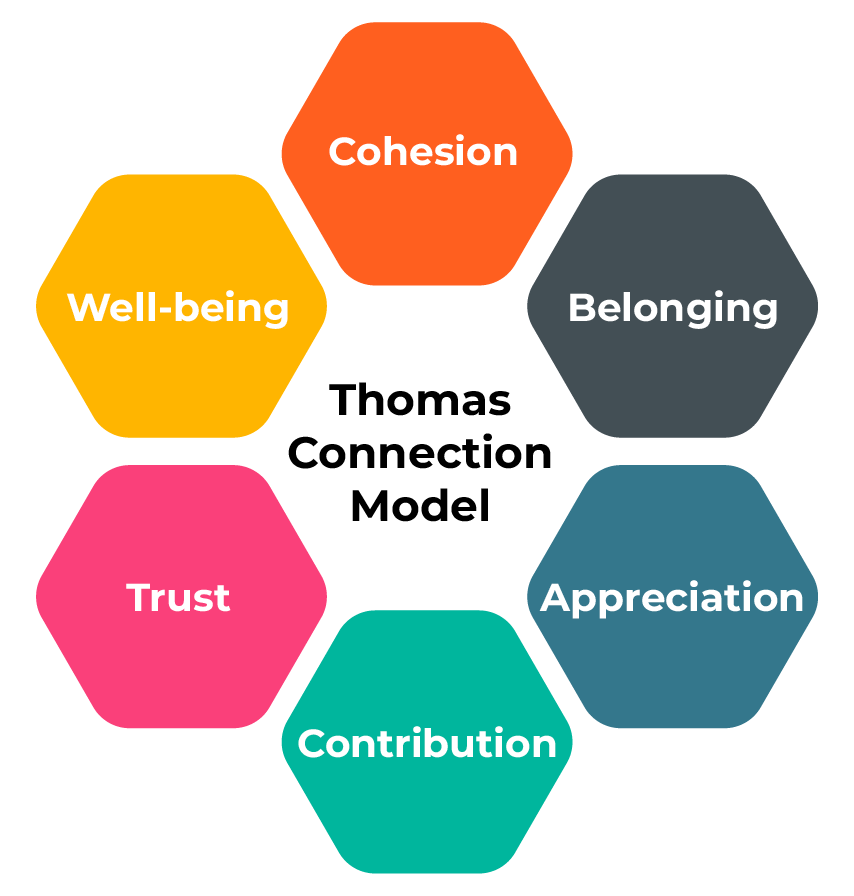
- Cohesion – Strong, trusting relationships within the team
- Belonging – A sense of inclusion and shared identity with colleagues
- Appreciation – Feeling valued and recognized at work
- Contribution – Confidence in one’s ability to add value to the team
- Trust – Psychological safety in interactions with colleagues and leadership
- Well-being – A sense of balance, resilience, and support at work.
Where traditional surveys leave you with a number, the Connection Measure gives you answers. Not just whether people are engaged, but why. That’s the intelligence leaders need to build more connected, resilient and high-performing teams.